
Coenzyme Q10 - particularly important for older people
When it was first discovered, Q10 was categorised as a vitamin, but it has lost this status - which is probably also due to the fact that such categorisations are usually made for "normal citizens" aged between 19 and 39. Unfortunately, from the age of 40, the body increasingly loses the ability to produce it itself! Read more

Q10 - Ubiquinol liquid, 50 ml
Content: 0.05 Liter (€1,600.00 / 1 Liter)
-
From 1€89.50€1,790.00 / 1 Liter
-
From 2€85.00€1,700.00 / 1 Liter
-
From 5€80.00€1,600.00 / 1 Liter

Ubiquinol Omega-3 with DHA + EPA, 150 capsules (manufacturer Biogenial)
| 50 mg Kaneka Ubiquinol Q10 per capsule. Dissolved in a patented matrix of EPA and DHA. |
Content: 0.07 Kilogramm (€1,027.14 / 1 Kilogramm)
-
From 1€79.90€1,141.43 / 1 Kilogramm
-
From 2€75.90€1,084.29 / 1 Kilogramm
-
From 5€71.90€1,027.14 / 1 Kilogramm

Coenzyme Q10 30 mg , 60 capsules
Content: 0.036 Kilogramm (€722.22 / 1 Kilogramm)
-
From 1€28.90€802.78 / 1 Kilogramm
-
From 2€27.40€761.11 / 1 Kilogramm
-
From 5€26.00€722.22 / 1 Kilogramm

Q10 Liquid Ubiquinone, 30 ml
Content: 0.03 Liter (€1,483.33 / 1 Liter)
-
From 1€49.50€1,650.00 / 1 Liter
-
From 2€47.00€1,566.67 / 1 Liter
-
From 5€44.50€1,483.33 / 1 Liter

Antioxidants WholeFood plus Q10, 60 capsules
Content: 0.051 Kilogramm (€703.92 / 1 Kilogramm)
-
From 1€39.90€782.35 / 1 Kilogramm
-
From 2€37.90€743.14 / 1 Kilogramm
-
From 5€35.90€703.92 / 1 Kilogramm
Not a vitamin, but hardly less important!
Coenzyme Q10 (CoQ10) is an antioxidant that occurs naturally in the body and is essential for cell energy production. It is involved in the production of the energy carrier ATP, protects cells from damage caused by free radicals and is found in foods such as meat, fish and vegetable oils. CoQ10 is not called a vitamin because the body can produce it itself. However, the body's own production decreases with age, so dietary supplements containing CoQ10 can support the body's own supply, especially for people who suffer from certain diseases or are older.
Properties of coenzyme Q10
- Energy production: CoQ10 is crucial for the mitochondrial respiratory chain, as it is involved in the production of ATP, the universal energy carrier of the cell.
- Antioxidant action: CoQ10 protects cells, including DNA, from free radical damage as a powerful antioxidant.
- Cell functions: CoQ10 plays an important role in the proper functioning of numerous organs and vital functions such as immune defence, nerve activity and muscle strength due to its multi-faceted function in metabolism.
Occurrence and production in the body itself
- The body's own synthesis: As the human organism can produce CoQ10 itself, it is not an essential nutrient.
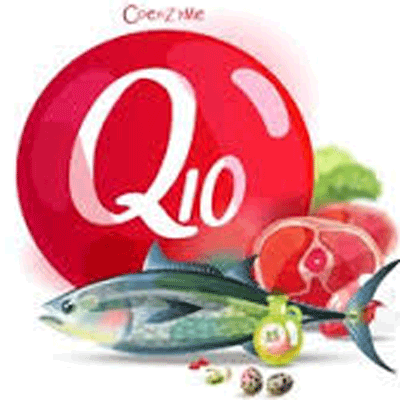
- Food sources: CoQ10 is absorbed in small amounts through the diet, particularly from offal, fish (such as sardines and mackerel), nuts, vegetable oils, pulses and certain vegetables (such as broccoli and spinach).
When it can be useful to use food supplements
- Ageing process: As we get older, the body's natural CoQ10 production decreases, which is why supplementation makes sense.
- Certain diseases: People with chronic conditions such as heart problems, diabetes, Parkinson's disease or cancer may have low CoQ10 levels.
- Statin intake: As cholesterol-lowering drugs (statins) can reduce CoQ10 levels in the body, supplementation can be useful to prevent muscle problems.