
Limit values for vitamins and minerals in food supplements
There are various indications for amounts of vitamins and minerals, e.g. on food supplements or in the literature. Below are some details to bring clarity to this.
Here is a table for a quick overview, but first an explanation of the column headings.
NRV
NRV is the abbreviation for Nutrient Reference Value. More precisely: "Nutritional Reference Values" or "reference values for nutrient intake". Although this value is obviously based on consumption recommendations for nutrient intake issued by European institutes such as the DGE, the legislator expressly emphasises that it is not a recommendation, but only a reference value without any scientific evaluation.
Accordingly, it is also wrong or shows a lack of expertise when suppliers of food supplements translate the NRV value, which must be indicated on labels, as "recommended daily intake". Unfortunately, this value is often really only a figure without much sense, since it was set a long time ago, i.e. in 2011, and has not been revised since. As science constantly develops, some of the figures are already absurdly outdated. For example, it is now clear for vitamin D that the recommendation at that time was far too low. Today it is recommended to take 20 µg vitamin D daily, whereas in 2011 it was still thought that 5 µg was sufficient. A food supplement with 20 µg vitamin D must therefore now state "400 % NRV" on the label; the layperson thinks this is massively overdosed, but in fact it contains just the absolutely necessary amount per day.
DACH:
DACH stands for Germany (D), Austria (A), Switzerland (CH).
Previously, the German Nutrition Society (DGE) was responsible for recommendations on nutrient intake. Each German-speaking country had its own approach. Some years ago it was realised that this was pointless and the recommendations were harmonised. Since then, Germany, Austria and Switzerland decide together what they recommend to their citizens and to medical professionals, which is referred to as the DACH recommendations. It is important to know that the DACH recommendations are aimed exclusively at healthy people. For people such as the chronically ill they have no relevance; such people often have completely different needs.
Upper Limit:
The UL (Upper Limit) is a value that refers to the harmless long-term daily intake over months or years for healthy people. If a therapist prescribes a significantly higher dose to a patient for a short period, there is certainly a reason for that, especially as that is then a dose for the sick and not for the healthy, and is only taken for a foreseeable period. But in the long term and without a special reason, the Upper Limit should not be exceeded.
The values published by EFSA (European Food Safety Authority) for the "Tolerable Upper Intake Level" (UL) are the most suitable guide as to how much of minerals and vitamins one can take daily without harming the body. The foundational work for this is actually "TOLERABLE UPPER INTAKE LEVELS FOR VITAMINS AND MINERALS" from 2006, but as this is almost 500 pages long and nearly 20 years old, we consider the following 8-page document from June 2024 to be much more appropriate: Overview on Tolerable Upper Intake Levels as derived by the Scientific Committee on Food (SCF) and the EFSA Panel on Dietetic Products, Nutrition and Allergies (NDA)
Maximum amounts Switzerland per daily intake
As regards Upper Limits or nutrient recommendations, Switzerland deviates strongly from the rest of the EU with its "Ordinance of the EDI on food supplements" since 2020.
Many aspects there puzzle nutrition scientists. For example, why Swiss citizens are allowed only 5.3 mg zinc per daily dose, while it is much higher in the rest of the EU—something that does not seem particularly problematic given an Upper Limit of 25 mg.
But regardless of what one thinks of the VNem or not, as an online retailer we must in any case comply with it. This means we may not ship food supplements to Switzerland that exceed the required maximum amounts even by one substance.
n.a.:
Some columns contain the entry n.a. (no data) or no indication. This may be because a substance is completely harmless or can be consumed in very large amounts. It may also be because there are simply no scientific data available. This is not always clearly described in the legal frameworks.
We therefore recommend referring to available values in such cases. If, for example, the European Upper Limit only shows n.a., one can orient oneself on the Swiss values or vice versa.
The following graphic from the Swiss Federal Office for Food Safety is intended to visually illustrate how recommendations and Upper Limits should be classified:
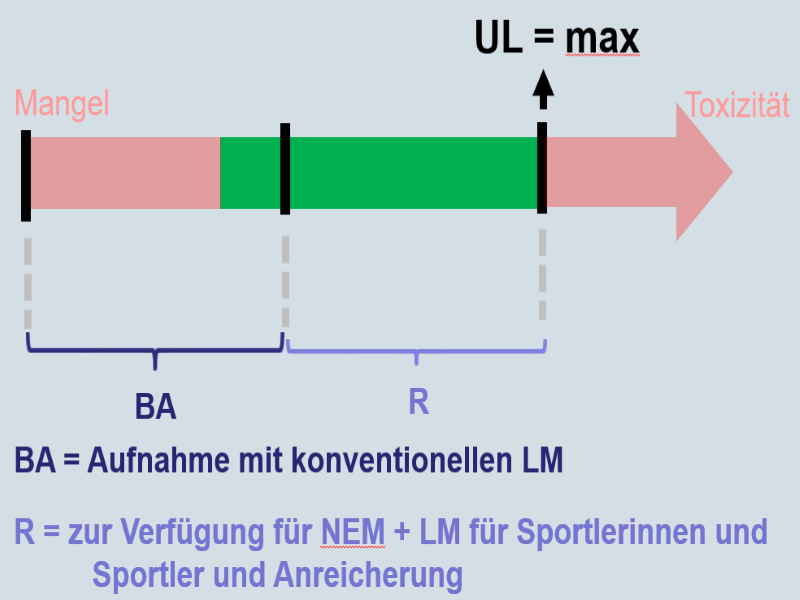
Brief explanation:
- BA = the area of normal diet. This is often rather unhealthy (red area); a small proportion of people, according to this graphic about 20%, manage to eat healthily
- R = the area in which food supplements can be sensible and healthy.
- About UL: Only a short-term exceedance may be acceptable for a short time, e.g. to correct concrete deficiency states. In the long term, however, this area should not be exceeded.
Tabular overview of limit values for vitamins and minerals in food supplements
|
Vitamin |
NRV1 | DACH (m/f 25-51 years)2 |
Upper Limit3 |
Maximum amounts Switzerland per daily intake according to VNem as at 1.2.2024 |
|
Vitamin A |
800 µg RE5,6 |
1000 µg / 800 µg |
3000 µg |
1360 µg (in the form of beta-carotene max. 8.2 mg)8 |
|
Vitamin D |
5 µg |
20 µg |
70 µg |
|
|
Vitamin E |
12 mg α-TE5 |
14 mg / 12 mg |
300 mg |
205 mg |
|
Vitamin K |
75 µg |
70 µg / 60 µg |
n.a. |
225 µg |
|
Vitamin C |
80 mg |
100 mg |
n.a. |
750 mg |
|
Thiamine |
1.1 mg |
1.2 mg / 1 mg |
n.a. |
free / no maximum amount |
|
Riboflavin |
1.4 mg |
1.4 mg / 1.2 mg |
n.a. |
free / no maximum amount |
|
Niacin7 |
16 mg NE5 |
16 mg / 13 mg |
900 mg (max. 10 mg nicotinic acid) |
600 mg, of which at most 10 mg as |
|
Vitamin B6 |
1.4 mg |
1.5 mg / 1.2 mg |
12 mg |
15 mg |
|
Folic acid |
200 µg |
400 µg |
1000 µg |
750 µg |
|
Vitamin B12 |
2.5 µg |
3 µg |
n.a. |
free / no maximum amount |
|
Biotin |
50 µg |
30 µg / 60 µg |
n.a. |
free / no maximum amount |
|
Pantothenic acid |
6 mg |
6 mg |
safe |
free / no maximum amount |
|
Mineral |
NRV1 |
DACH (m/f 25-51 years)2 |
Upper Limit3 |
Maximum amounts Switzerland per daily intake according to VNem as at 1.2.2024 |
|
Potassium |
2000 mg |
2000 mg |
n.a. |
2250 mg |
|
Chloride |
800 mg |
830 mg |
n.a. |
only as accompaniment |
|
Calcium |
800 mg |
1000 mg |
2500 mg |
750 mg |
|
Phosphorus |
700 mg |
700 mg |
n.a. |
only as accompaniment |
|
Magnesium |
375 mg |
350 mg / 300 mg |
250 mg9 |
375 mg |
|
Iron |
14 mg |
10 mg / 15 mg |
n.a. |
21 mg |
|
Zinc |
10 mg |
10 mg |
25 mg |
5.3 mg |
|
Copper |
1 mg |
1 mg / 1.5 mg |
5 mg |
1.6 mg |
|
Manganese |
2 mg |
2 mg / 5 mg |
n.a. |
3 mg |
|
Fluoride |
3.5 mg |
3.8 mg / 3.1 mg |
7 mg |
n.a. |
|
Selenium |
55 µg |
10-70 µg |
255 µg |
165 µg |
|
Chromium |
40 µg |
30 µg / 100 µg |
n.a. |
188 mg |
|
Molybdenum |
50 µg |
50 µg / 100 µg |
600 µg |
300 µg |
|
Iodine |
150 µg |
200 µg |
600 µg |
200 µg |
Sources:
1 NRV (Nutrient Reference Value): Food Information Regulation LMIV (REGULATION (EU) No 1169/2011 OF THE EUROPEAN PARLIAMENT AND OF THE COUNCIL) – Reference value for the information on the packaging / can, not identical with the "daily requirement" according to the DGE!
2 German Nutrition Society, Austrian Nutrition Society, Swiss Society for Nutrition Research, Swiss Association for Nutrition (eds.): Reference values for nutrient intake. Bonn, 2nd edition, 1st issue (2015) – Medically and scientifically established daily requirement!
3 EFSA (European Food Safety Authority). Tolerable upper intake levels for vitamins and minerals. European Food Safety Authority, Parma, Italy. 2006. – n.a. = No data due to lack of scientific basis; Safe = No indication because not toxic even in large amounts – Scientifically established value, should be adhered to, possibly the basis for later EU-wide statutory maximum limits!
5 Unit designation according to COMMISSION REGULATION (EC) No 1170/2009 of 30 November 2009. The indication of vitamin E content (α-TE = total alpha-tocopherol equivalents) refers to the activity of the different forms of vitamin E. 1 mg aTE corresponds to: 1 mg alpha-tocopherol, 2 mg beta-tocopherol, 4 mg gamma-tocopherol, 100 mg delta-tocopherol, 3.3 mg alpha-tocotrienol, 6.6 mg beta-tocotrienol, 13.2 mg gamma-tocotrienol
6 Some carotenoids are converted into vitamin A in the body and must be indicated in the table converted into RE = retinol equivalent. 6 mg beta-carotene or 12 mg other carotenoids (lycopene, lutein, zeaxanthin) correspond to 1 mg vitamin A. Regarding a toxic increase in vitamin A intake, beta-carotene plays no role, but a high intake carries other health risks. Therefore, supplements with >= 2 mg beta-carotene must carry the notice: Beta-carotene should not be taken over a long period by heavy smokers (>20 cigarettes/day) (source).
7 Nicotinic acid + nicotinamide are toxicologically different, therefore UL nicotinic acid 10 mg, UL nicotinamide 900 mg. The BfR recommends using only nicotinamide!
8 Vitamin A can be easily overdosed. Therefore, in Germany there are few pure vitamin A preparations; beta-carotene is usually added, from which the body can form vitamin A without risk of overdose. This is probably also the reason why Switzerland does not allow pure vitamin A in food supplements at all!
9 An Upper Limit that is lower than the daily requirement sounds illogical at first. However, one must know that this limit of 250 mg per day refers only to what should be taken daily from food supplements. Above this, problems such as diarrhoea could occur. This is the opinion at least of the BfR and EFSA. There is therefore no prohibition due to severe health hazards, and it is questionable whether an individual would really react that way — reactions may vary. That is why the Swiss are more relaxed with a maximum amount of 375 mg. Ultimately, everyone should test this for themselves; diarrhoea for a short time is not a dangerous side effect.
Vitamins + minerals: Permitted substances
Permitted substances in the EU + EEA according to COMMISSION REGULATION (EC) No 1170/2009 of 30 November 2009
Vitamins A to E are by no means uniform substances. For example, vitamin B12 comprises at least 4 substances that act in the body in the same way, can partly be converted into each other and may therefore all be referred to as "B12".
Minerals cannot be taken in pure form. Most people recall from chemistry lessons what would happen if one ingested potassium in its pure form or mixed it with water. See here: https://www.youtube.com/watch?v=i8DiLjGc3pA, so one should not attempt to cover one’s potassium requirement with pure potassium! Therefore minerals and trace elements must always be taken in the form of chemical compounds that are harmless to the body and from which the body can extract the elements via digestion or conversion.
There is therefore a very large selection of chemical compounds that manufacturers of food supplements and medicines can use to fortify their products with vitamins and minerals.
Some of these are better absorbed, some worse. Some are permitted in the EU, others can only be obtained from abroad because they are not approved here, often for safety reasons.
>In the past, many very good compounds were not approved in Germany; the new EU Regulation No. 1170/2009 has brought significant improvements here. Important highly valuable substances, such as methylcobalamin or iron bisglycinate, were previously forbidden but are now permitted, to the great advantage of consumers.
In our online shop you will find only selected products that contain substances with the highest bioavailability. This distinguishes our range from the usual supermarket, drugstore and pharmacy products.
Below is a current list of all substances permitted in the EU for fortification with vitamins and minerals:
|
Vitamins |
Permitted compounds |
Minerals |
Permitted compounds |
|
Vitamin A |
Retinol, Retinyl acetate, Retinyl palmitate, Beta-carotene |
Potassium |
Potassium bicarbonate, potassium carbonate, potassium chloride, potassium citrate, potassium gluconate, potassium glycerophosphate, potassium lactate, potassium hydroxide, potassium L-pidolate, potassium malate, potassium salts of orthophosphoric acid |
|
Vitamin D |
Cholecalciferol, Ergocalciferol |
Calcium |
Calcium acetate, calcium L-ascorbate, calcium bisglycinate, calcium carbonate, calcium chloride, calcium citrate malate, calcium salts of citric acid, calcium gluconate, calcium glycerophosphate, calcium lactate, calcium pyruvate, calcium salts of orthophosphoric acid, calcium succinate, calcium hydroxide, calcium L-lysinate, calcium malate, calcium oxide, calcium L-pidolate, calcium L-threonate, calcium sulfate |
|
Vitamin E |
D-alpha-tocopherol, DL-alpha-tocopherol, D-alpha-tocopheryl acetate, DL-alpha-tocopheryl acetate, D-alpha-tocopheryl succinate, mixed tocopherols, tocotrienol-tocopherol |
Magnesium |
Magnesium acetate, magnesium ascorbate, magnesium bisglycinate, magnesium carbonate, magnesium chloride, magnesium salts of citric acid, magnesium gluconate, magnesium glycerophosphate, magnesium salts of orthophosphoric acid, magnesium lactate, magnesium L-lysinate, magnesium hydroxide, magnesium malate, magnesium oxide, magnesium L-pidolate, magnesium potassium citrate, magnesium pyruvate, magnesium succinate, magnesium sulfate, magnesium taurate, magnesium acetyltaurate |
|
Vitamin K |
Phylloquinone (phytonadione), menaquinone |
Iron |
Iron carbonate, iron citrate, iron ammonium citrate, iron gluconate, iron fumarate, iron sodium diphosphate, iron lactate, iron sulfate, iron diphosphate (iron pyrophosphate), iron saccharate, elemental iron (electrolytic, carbonyl or hydrogen-reduced), iron bisglycinate, iron L-pidolate, iron(II) phosphate, iron(II) taurate |
|
Vitamin C |
L-ascorbic acid, sodium L-ascorbate, calcium L-ascorbate, potassium L-ascorbate, L-ascorbyl-6-palmitate, magnesium L-ascorbate, zinc L-ascorbate |
Zinc |
Zinc acetate, zinc L-ascorbate, zinc L-aspartate, zinc bisglycinate, zinc chloride, zinc citrate, zinc gluconate, zinc lactate, zinc L-lysinate, zinc malate, zinc mono-L-methionine sulfate, zinc oxide, zinc carbonate, zinc L-pidolate, zinc picolinate, zinc sulfate |
|
Thiamine |
Thiamine hydrochloride, thiamine mononitrate, thiamine monophosphate chloride, thiamine pyrophosphate chloride |
Copper |
Copper carbonate, copper citrate, copper gluconate, copper sulfate, copper L-aspartate, copper bisglycinate, copper-lysine complex, copper(II) oxide |
|
Riboflavin |
Riboflavin, riboflavin-5′-phosphate, sodium |
Manganese |
Manganese ascorbate, magnesium L-aspartate, manganese bisglycinate, manganese carbonate, manganese chloride, manganese citrate, manganese gluconate, manganese glycerophosphate, manganese pidolate, manganese sulfate |
|
Niacin |
Nicotinic acid, nicotinamide, inositol hexanicotinate (inositol niacinate) |
Fluorine |
Calcium fluoride, potassium fluoride, sodium fluoride, sodium monofluorophosphate |
|
Vitamin B6 |
Pyridoxine hydrochloride, pyridoxine-5′-phosphate, pyridoxal-5′-phosphate |
Selenium |
L-selenomethionine, selenium yeast, selenous acid, sodium selenate, sodium hydrogen selenite, sodium selenite |
|
Folic acid |
Pteroylmonoglutamic acid, calcium L-methylfolate, 5MTHF-glucosamine |
Chromium |
Chromium(III) chloride, chromium(III) lactate trihydrate, chromium nitrate, chromium picolinate, chromium(III) sulfate |
|
Vitamin B12 |
Cyanocobalamin, hydroxocobalamin, 5′-deoxyadenosylcobalamin, methylcobalamin |
Molybdenum |
Ammonium molybdate (molybdenum (VI)), sodium molybdate (molybdenum (VI)) |
|
Biotin |
D-biotin |
Iodine |
Sodium iodide, sodium iodate, potassium iodide, potassium iodate |
|
Pantothenic acid |
Calcium D-pantothenate, sodium D-pantothenate, D-panthenol, Pantethine |
Chloride and Phosphorus |
may also be added according to the supplements regulation, but are practically insignificant as they are not deficiency substances. |
|
Other permitted substances |
Boric acid, sodium borate, choline-stabilised orthosilicic acid, silicon dioxide, silicic acid (in gel form) |
||
Sources:
REGULATION (EC) No 1170/2009 OF THE COMMISSION of 30 November 2009 amending Directive 2002/46/EC of the European Parliament and of the Council and Regulation (EC) No 1925/2006 of the European Parliament and of the Council as regards the lists of vitamins and minerals and of their forms of salts and derivatives which may be added to foods or used in the manufacture of food supplements. Entry into force on 10.01.2010 (20 days after publication in the Official Journal of the European Union on 21.12.2009).
COMMISSION IMPLEMENTING DECISION of 19 March 2014 authorising the placing on the market of (6S)-5-methyltetrahydrofolic acid, glucosamine salt as a novel food ingredient pursuant to Regulation (EC) No 258/97 of the European Parliament and of the Council