Secondary plant compounds, also known as phytonutrients - key to health
Plants are, first and foremost, concerned with not being eaten by us or any other animal or insect. They also aim to ward off bacteria and viruses to protect themselves. For these purposes they produce active substances that can often have positive health effects for us when the plant is consumed.
On this page you will find products whose main purpose is to exert a positive effect through secondary plant compounds. Products such as multivitamin preparations, where these compounds are only present in small amounts, are not included here in order to maintain clarity. That does not mean that these are any less useful, because many secondary plant compounds also act synergistically with vitamins and minerals. That means they complement them ideally... Read more


Vitamin C with bioflavonoids, 120 tablets
Contents/Net quantity: 0.126 Kilogramm (€269.84 / 1 Kilogramm)

Vitamin C with bioflavonoids, 60 tablets
Contents/Net quantity: 0.064 Kilogramm (€289.06 / 1 Kilogramm)

Vitaya Oil with Sea Buckthorn Carotenes, 50 ml
Contents/Net quantity: 0.05 Liter (€620.00 / 1 Liter)
Our diet, i.e. the substances in foods, are divided into primary nutrients and secondary nutrients
Primary nutrients are familiar to everyone and easy to understand:
- Protein
- Fats
- Carbohydrates
Secondary plant compounds are less easy to understand, very diverse and also indispensable for our health, although not yet fully researched.
Classification of secondary plant compounds
Depending on the perspective from which one wishes to consider these substances, they can be classified in different ways, e.g. by chemical group, appearance or taste, role for the plant, effect on our health...
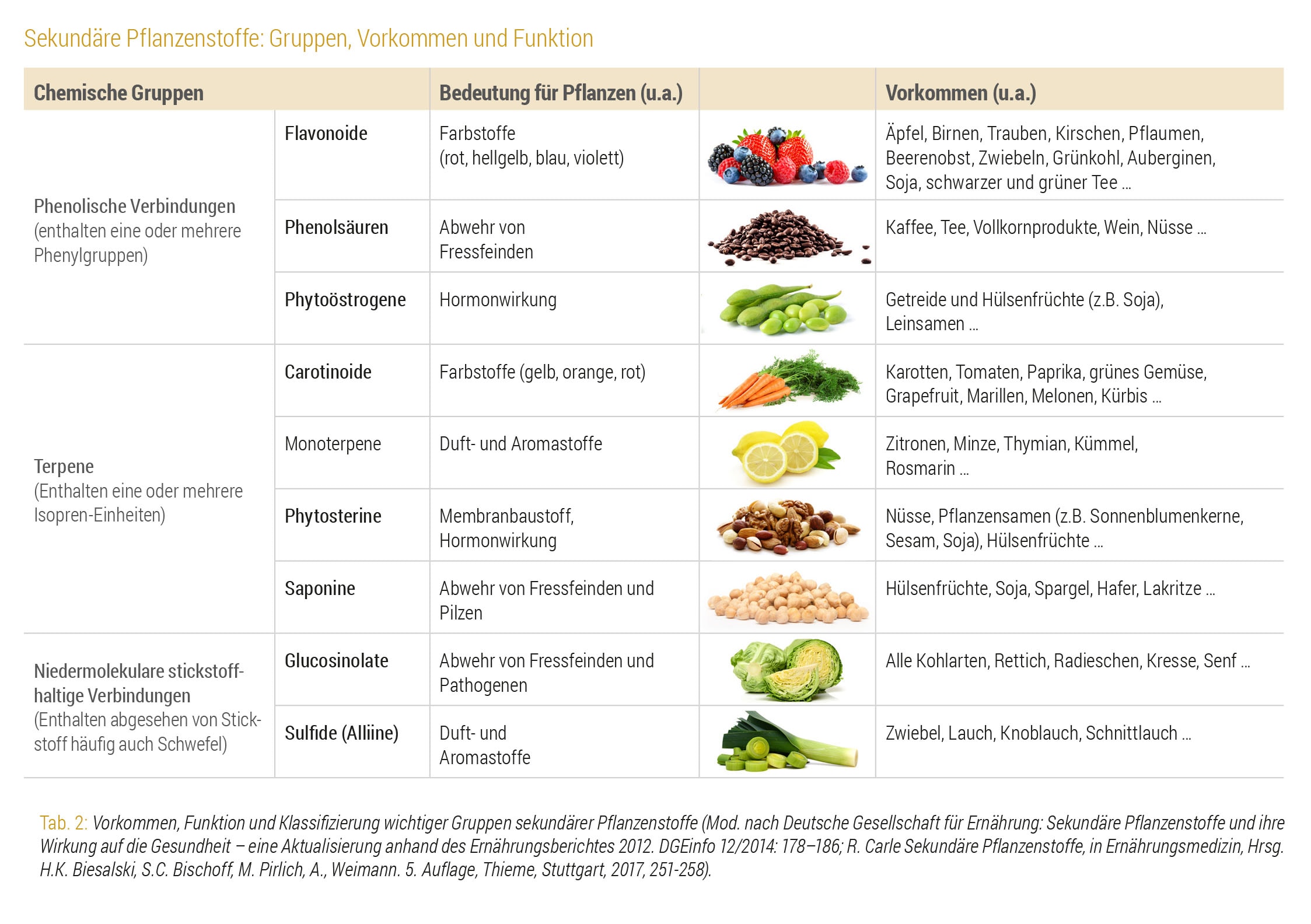
A very good overview can be found at a highly qualified nutrition-science source, the German Nutrition Society:
Table 3 | Overview of secondary plant compounds and their possible health-promoting effects
| Secondary plant compounds | e.g. found in ... | Importance for the plant | Possible health effects (predominantly animal and in-vitro studies) | Influence on human health (epidemiological studies) |
| Flavonoids | Apples, pears, grapes, cherries, plums, berries, onions, kale, aubergines, soy, black and green tea, and more | Pigments (red, light yellow, blue, violet) |
|
Association with
reduced risk for
|
| Phenolic acids | Coffee, tea, wholegrain products, white wine, nuts | Defence substances against herbivores |
|
Association with
reduced risk for
|
| Carotenoids | Carrots, tomatoes, peppers, green vegetables (spinach, kale), grapefruit, apricots, melons, pumpkin | Pigments (yellow, orange, red) |
|
Association with
reduced risk for
|
| Phytoestrogens | Cereals and legumes (e.g. soybeans), flaxseed | Plant hormones that are structurally similar to the female sex hormone oestrogen |
|
|
| Glucosinolates | all types of cabbage, radish, radishes, cress, mustard | Defence substances against herbivores or pathogens |
|
Association with
reduced risk for
|
| Sulphides | Onions, leeks, garlic, chives | Fragrant and flavour compounds |
|
Association with
reduced risk for
|
| Monoterpenes | Mint, lemons, caraway | Fragrant and flavour compounds |
|
|
| Saponins | Legumes, soy, asparagus, oats, liquorice | Bitter substances (in aqueous solution: foaming action) |
|
|
| Phytosterols | Nuts and plant seeds (sunflower seeds, sesame, soy), legumes | Membrane building blocks, plant hormones that are structurally similar to cholesterol |
|
|
(Source: Watzl and Rechkemmer 2004, Watzl 2008, Watzl 2012)
https://www.dge.de/wissenschaft/fachinformationen/sekundaere-pflanzenstoffe-und-die-gesundheit/ accessed on 13/02/2026
Intake of secondary plant compounds
Of course, in our opinion it is best to obtain these substances in their natural form. We are not among those who claim that a healthy diet would no longer be possible and that one absolutely must take supplements!
So: a healthy whole-food diet, based on the Mediterranean diet, with a high content of fresh fruit and vegetables, as raw as possible (where it makes sense — some secondary substances like lycopene from tomatoes are better absorbed from cooked form!).
Preferably from an organic shop, because today's intensive agriculture with its pesticides, fertilisers and short growing periods produces plants that contain only a low level of secondary compounds.
However, there can be situations or circumstances in which intake in the form of extracts in capsules and tablets can make sense, for example:
- If one wants to achieve something specific with a high dose of a substance. For example, one could not possibly obtain the amount of broccoli whose active substances are contained in a capsule of broccoli extract through normal broccoli consumption — you would have to eat kilos of it every day!
- If one cannot eat a wholesome diet and shop at an organic store. For example because one is employed and has no time to cook fresh food constantly, cannot afford to shop at an organic shop, or simply — and this exists and must be accepted — one just does not feel like dealing with healthy eating and consciously eats whatever "comes along".
- If one cannot eat everything because of illnesses. An allergy can, for example, radically exclude certain foods. Someone with a bowel disease such as Crohn's disease or ulcerative colitis will certainly agree that they cannot just eat a large portion of cabbage or legumes without serious consequences!
For all these people, dietary supplements containing secondary plant compounds can make a lot of sense!
For people who are more visually oriented, for a better overview here once again in colour: